Encadre Rouge
From miniature painting to monumental canvas, from shoe design to digital art, from ancient mosaic to artificial intelligence — Vilma Mooradian Tawilian has spent over two decades asking the same question in every medium: how do craft, beauty, and innovation meet in a single object?
The foundation
Vilma trained at three of America's most demanding creative institutions — the California Institute of the Arts, the Fashion Institute of Design & Merchandising, and ArtCenter College of Design in Pasadena. From her earliest years, she moved fluidly among disciplines: fine art, graphic design, fashion, and the history of handcrafted objects. After graduation, she worked as a professional graphic designer, building visual identities, logos, and catalogs for brands — precise, commercial work that sharpened an eye for composition and the relationship between image and meaning that still runs through everything she makes.
Fashion
In 2009, Vilma moved into fashion, designing shoes — one of the most technically exacting disciplines in the industry. From footwear, she moved into exotic skin accessories, jewelry, working alongside Italian artisans whose knowledge of rare materials and handicraft represented a disappearing tradition. That collaboration between artist and artisan became the origin of Encadre Rouge — a creative house built on the belief that luxury objects and fine art share the same root: the desire to make something that outlasts the moment it was made.
The artist
Long before digital tools existed, Vilma was painting. At a young age, she completed a monumental acrylic work — a Persian bath scene measuring eight feet by five feet — a scale that demands both physical commitment and total compositional control. She went on to win multiple awards in miniature painting and ink and wash, disciplines that require an entirely different mastery: the patience to hold an entire world in the smallest possible space.
She never stopped learning. Through every phase of her professional life, she kept painting, kept pushing into new territory — from traditional canvas to digital composition, from 3D to the frontier tools of today. The question was always the same: what does this medium make possible that nothing else can?
The signature
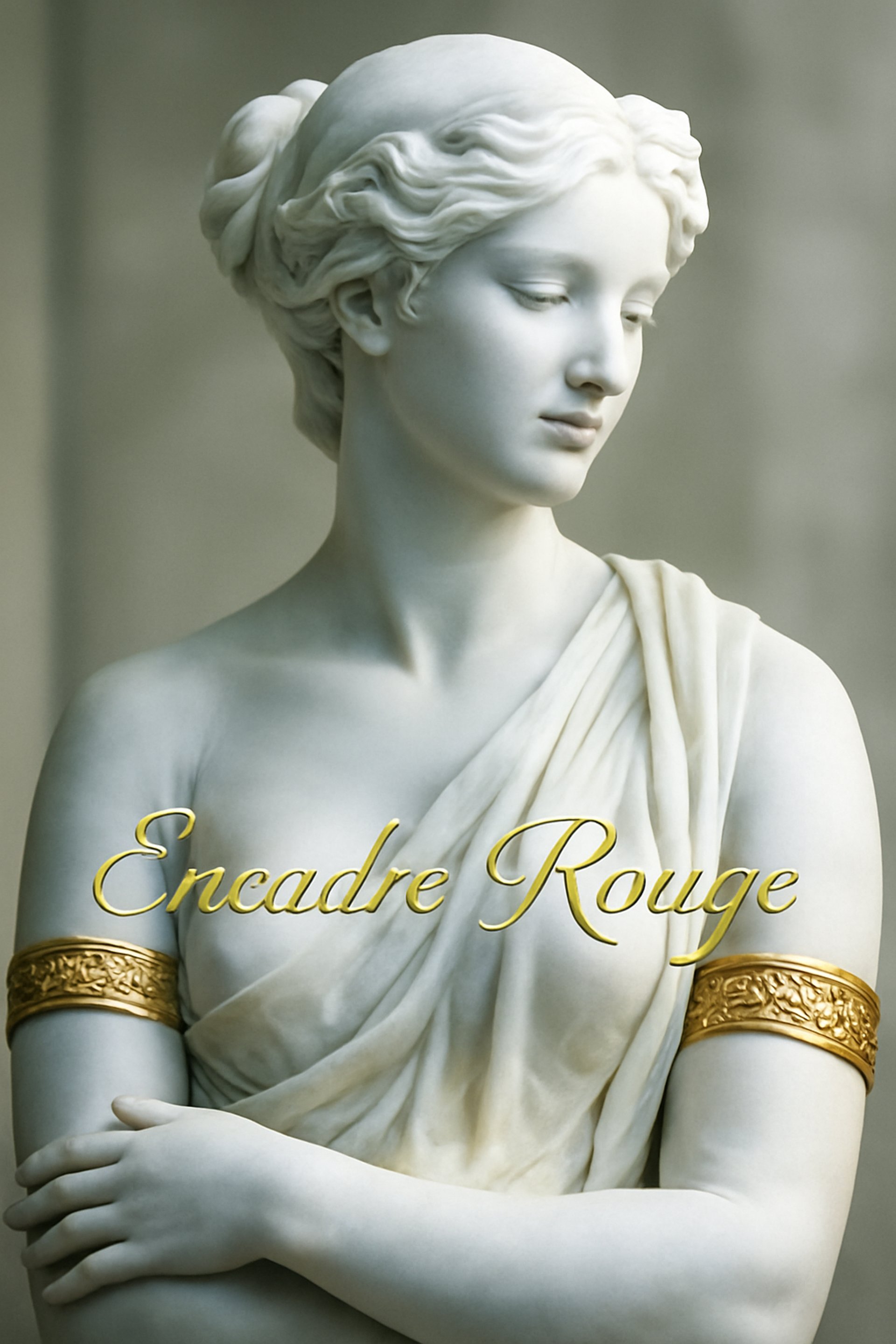
Small mosaic fragments appear in almost every work Vilma makes — scattered geometric pieces embedded in paint, photography, and digital composition. Immediately recognizable, they connect her contemporary practice to ancient Byzantine, Roman, Persian, and Armenian artistic traditions. Alongside the mosaics, a pearl recurs across her work: a symbol of transformation, hidden value, and time. Together with gold surfaces, classical figures, and gestural marks, these elements form a complete visual language — one that has developed organically over decades, never designed, always discovered.
ARTIST STATEMENT
My work begins where mediums collide. I paint on canvas with the urgency of gesture — loose, fast, physical — then return through the digital, adding layers of photography, drawing, and light until the surface holds something that no single hand could have made alone.
Fragments of mosaic appear in almost everything I make — small geometric pieces scattered across paint, photography, and digital composition. I did not decide to make them my signature. They kept appearing, and eventually I understood why. Some things are older than the artist making them.
These mosaic fragments connect my contemporary practice to traditions thousands of years old — Byzantine, Roman, Persian, and Armenian. They are the oldest layer in the work, even when they appear last. Alongside them, a pearl recurs: held, offered, suspended. Transformation made visible. Something irritating that became something beautiful over a long period of time.
I am interested in what happens when time folds: when a baroque sculpture surfaces through gold paint, when a gestural brushstroke reappears as a digital mark, when ancient mosaic fragments scatter across a contemporary composition. Each piece is an archaeology of its own making — a record of decisions, erasures, and accidents that gradually organize themselves into something that feels inevitable.
The thread across all my work is energy in layered form. Whether I am working with acrylic on canvas, composing digitally, or manipulating photographs, the question is always the same: how many realities can one surface hold before it becomes its own?
© 2025 Encadre Rouge (V2T2LLC) · Vilma Mooradian Tawilian · Miami, FL · All rights reserved
All artworks, images, and designs are the exclusive property of Vilma Mooradian Tawilian. No reproduction without written permission.
© 2025 Encadre Rouge (V2T2LLC)
Vilma Mooradian Tawilian · All rights reserved · Miami, FL
Contact: info@encadrerouge.com
Instagram:https://www.instagram.com/encadrerouge